FlexFinder · by Snowhow

You don't choose ski boot flex by level. You choose it by physics.

In Bernt Blankholm's experience, nine out of ten beginner and intermediate skiers are on the wrong flex index, most often too low. Beginners hurt, feel out of balance and are afraid of falling. Intermediates stop getting better, and difficult terrain, hard snow and deep snow get scary. Your body and how you actually ski decide the flex index you need, not your level. Get it right, and skiing can feel the way it should: less pain, better balance, real progress, and skiglede, the joy of skiing.

Find the boot flex that supports your skiing
FlexFinder result screen: your flex number 110, Under-supported. Your boot is a 100, 10 points too low for how you ski.
Two to three runs, phone in your pocket229 boots, 11 brands, no favouritesWe sell no boots. Ever.

Why it matters

Do you struggle to learn or to make progress in your skiing?

Six short parts in plain words, one for each picture in the App Store. Start with the one that sounds like you.

1 · What it feels like

Me: “Let’s turn.”
My skis: “Let’s not.”
My boots: “Told you so.”

Fix your boots, and your skis will follow.

If skiing felt harder than it should, some of this may sound familiar.

What I see on the bench, every week

  • It's difficult to learn.
  • You struggle to relax, to stay in balance.
  • The boot gives you no support.
  • You curl up your toes to try to keep your balance.
  • No support forward or backward.
  • The ski lives its own life.

Intermediates tell me something else: they stop getting better, and difficult terrain, hard snow or deep snow gets scary.

“Most people blame themselves. In my experience, it's often the boot that doesn't support them.”

BBBernt Blankholm, ski racer, coach for over 40 years, boot and ski developer. What he sees at his bench, not a study.

Most beginners don't stay with skiing. In the US, only about 1 in 5 beginners go on to become regular skiers. Many reasons play a part. We believe the boot is one overlooked reason.

Two to three runs to check your boot
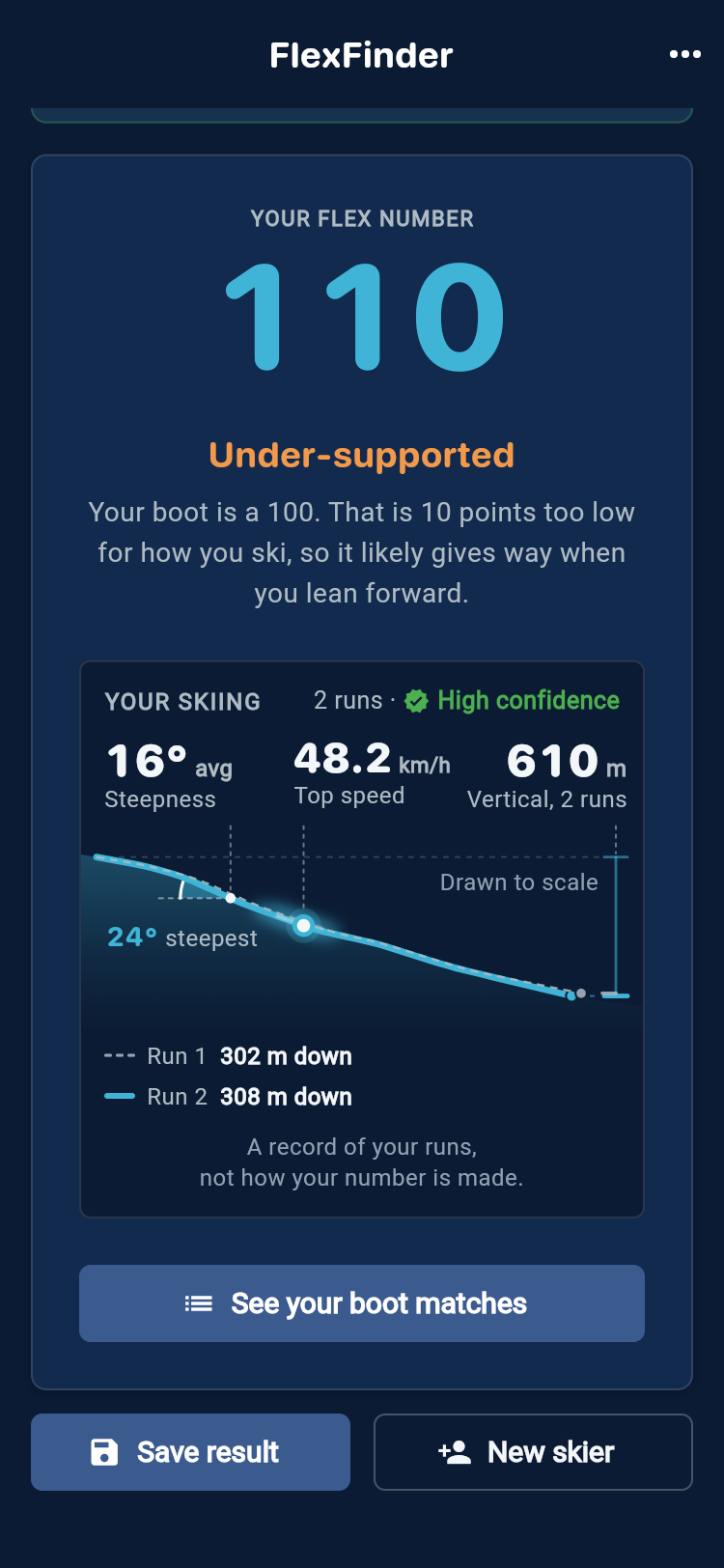
Result: 110, Under-supported

2 · What's happening

The boot does not give you the right support. So you blame yourself.

“Nine out of ten beginners and intermediates I see are on the wrong flex index, most often too low, especially if they are tall or heavier.”

BBBernt Blankholm, ski racer, coach for over 40 years, boot and ski developer. His observation, not a study.

A boot with the right flex index keeps you in balance, front to back. When you bend your ankles forward, it turns that into pressure on the tip of the ski. The ski bends; the boot barely does. When the boot doesn't support you in balance, your body tightens up. You try to hold yourself: with your thighs, your calves and your toes.

Often the flex indexNo support forward. Thighs burn, calves cramp.

Bootfitters report that when the flex index is too low for you, the boot gives way when you lean forward, your weight drifts back onto your heels, and your legs do the work. Too high is no better: you can't bend your ankles, so you can't get forward either.

Who can help: FlexFinder estimates your flex index.
Often the fitCurled, gripping toes. A heel that lifts.

Curled toes often mean the boot is too big. There is room to move, so your toes grab to hang on. The US ski-area trade magazine has called boot fit beginners' number-one stumbling block.

Who can help: your bootfitter.

Either way, the boot isn't holding you. It can be both, which is why we send you to a fitter with your number.

These are signs, not a diagnosis. Technique, tiredness, snow and skis play a part too, and what bootfitters report comes from practice, not from controlled studies.

Too low gives way. Too high holds you back.
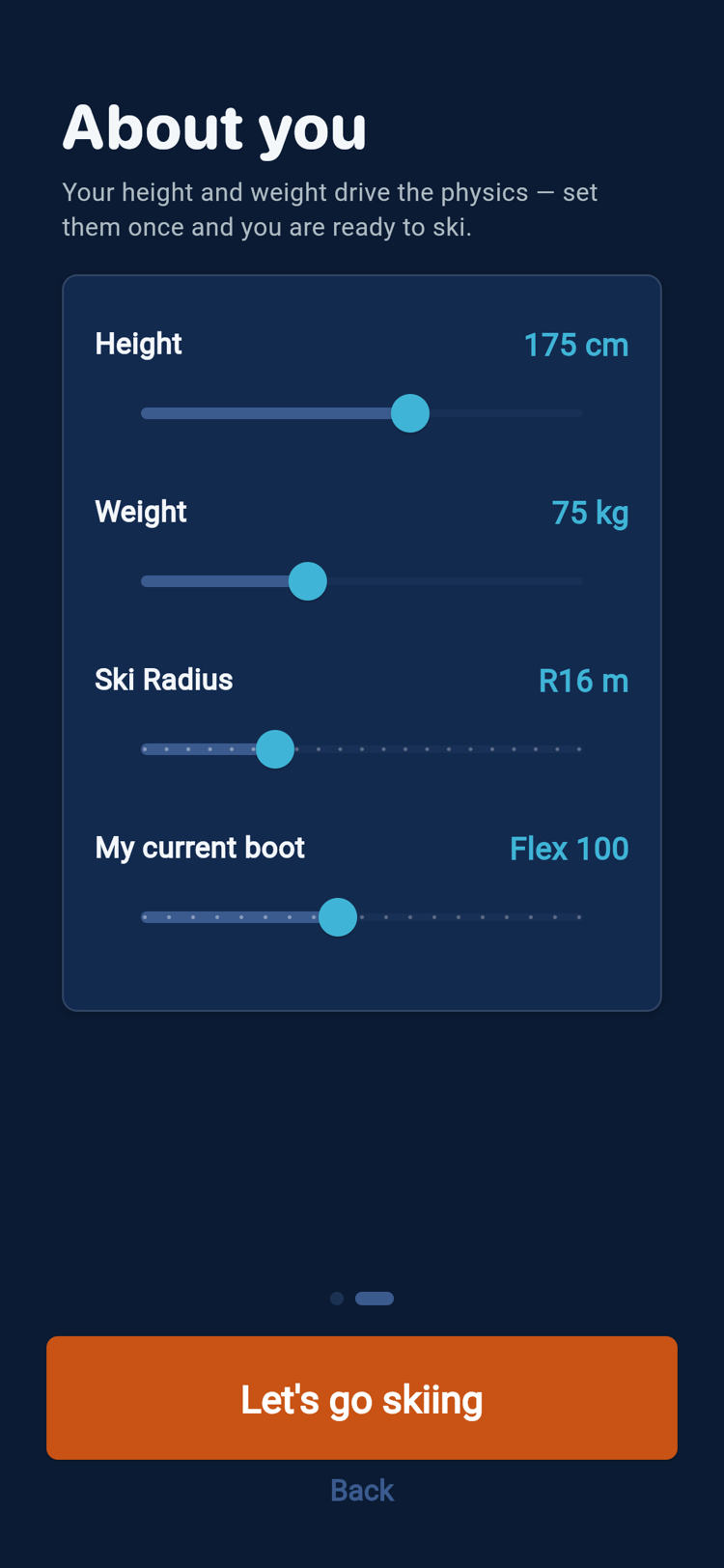
About you: height, weight, ski radius, current boot flex 100

3 · How it works

Phone in your pocket. Two to three runs.

Tell the app your height, your weight, your ski sidecut (the radius printed on the ski) and the flex index of your ski boots. Then go skiing. Any run you're happy on.

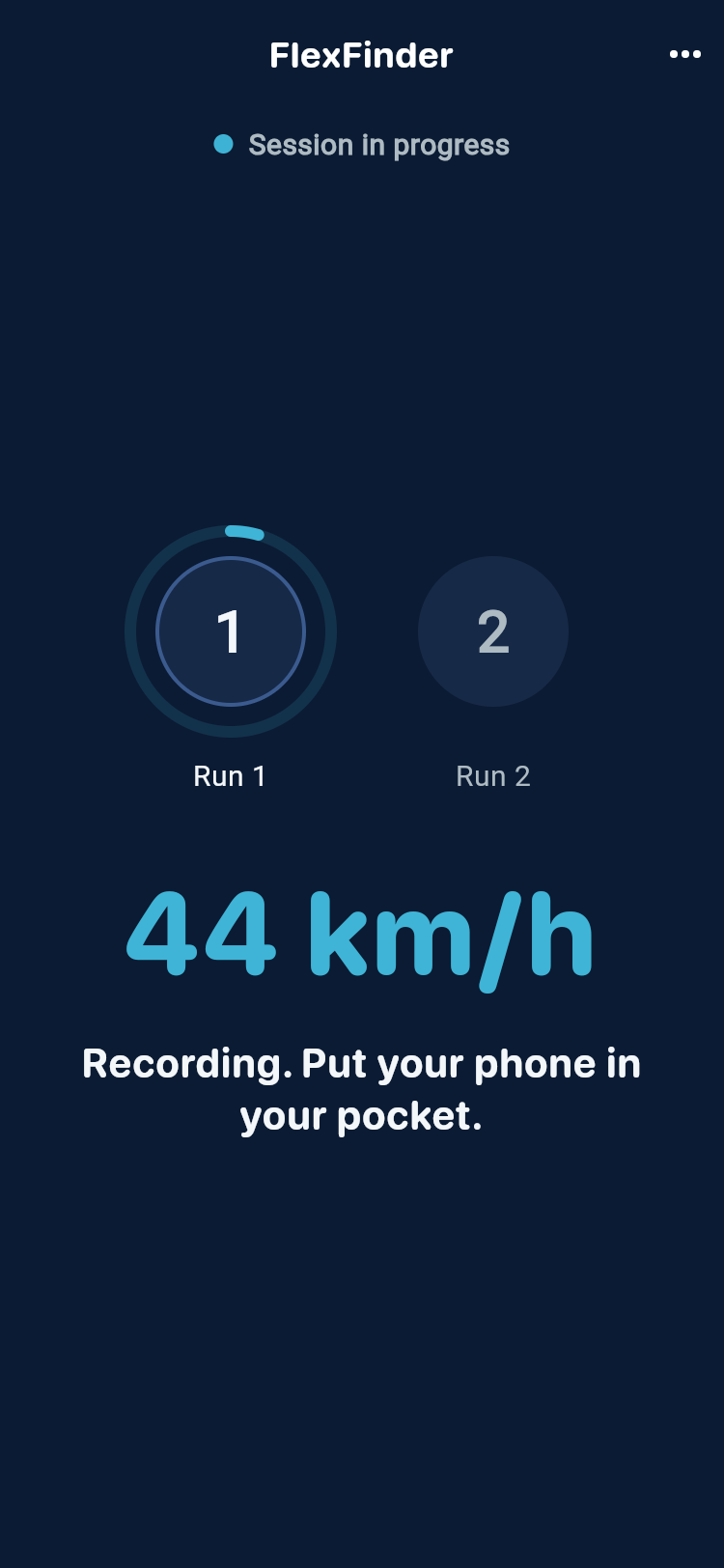
The app records your skiing with several of your phone's sensors, and a physics model calculates your number. It spots each run on its own, so there is nothing to press on the hill. After two to three runs, you have your number.

The calculation is calibrated against real-world skiing data from thousands of sessions.

Runs found on their own
Session screen: recording run 1

4 · Your result

Identifies your flex index.

You get one number: your flex index. For example 110.

It isn't exact to the last point, and it doesn't need to be. The number on a boot isn't standardised either, so in the store you and your bootfitter try boots around your number. For a 110, that naturally means boots from about 105 to 115.

Then a verdict on the boot you own: too low, too high, or right. If yours is a 100 and your number is 110, the app tells you in plain words: 10 points too low for how you ski.

Too high is not the answer either. In the one controlled on-snow study we know of, beginners in high-flex boots learned worse. It was small, with 1980s boots, and flex was not matched to body weight. That is our point: the right flex index for your body.

One number, not a guess at your level
Result: 110, Under-supported

5 · The root cause

Your level depends on where you learned. Your physics doesn't.

In the shop you're asked your level. Most flex charts we reviewed start there. Your weight, if it appears, is usually a footnote, and none of the charts or boot finders we reviewed measure how you actually ski. FlexFinder does, from two to three runs: it records your skiing with your phone's sensors and works out what your boot has to handle.

Level is a poor guide. Nobody rates it the same way, not even you. In our experience, a beginner from Mexico and a beginner from Austria are not the same skier.

Your body is the same wherever you learned, and so is the physics of your skiing. That's why FlexFinder asks about your body and measures how you ski, instead of asking your level.

None of this is the shop's fault. The model is what's broken: flex has long been sold by ability level and by price. We think price shouldn't decide your flex.

Your body, not your level

Why your level misleads

ISO 11088The binding standard takes your skier type “as assessed by the skier”.
Norway · 512 skiers and snowboardersHow people rated themselves agreed only “low to fair” with a watched test run.
NetherlandsAbout 4 in 5 recreational skiers rated themselves higher than ski instructors did.
“Level 3”Still a wedge at one US ski school. Parallel turns at another in Canada.

6 · In the shop or rental

Walk in knowing your number.

Take your number to a bootfitter, or to the rental counter. They handle the fit: length, width, shape, your feet, and those curled toes. You bring the flex index. Your fitter is on your side.

MythA low flex index is comfortable.
FactComfort comes mainly from fit: the width and shape of the boot.

Bootfitters treat width and flex as two separate choices. Width and shape are for your foot. Flex is for your body and how you ski.

58

of 229 boots, from all 11 brands, have a flex index of 120 or more in a wide fit (100 mm or wider).From the FlexFinder boot list

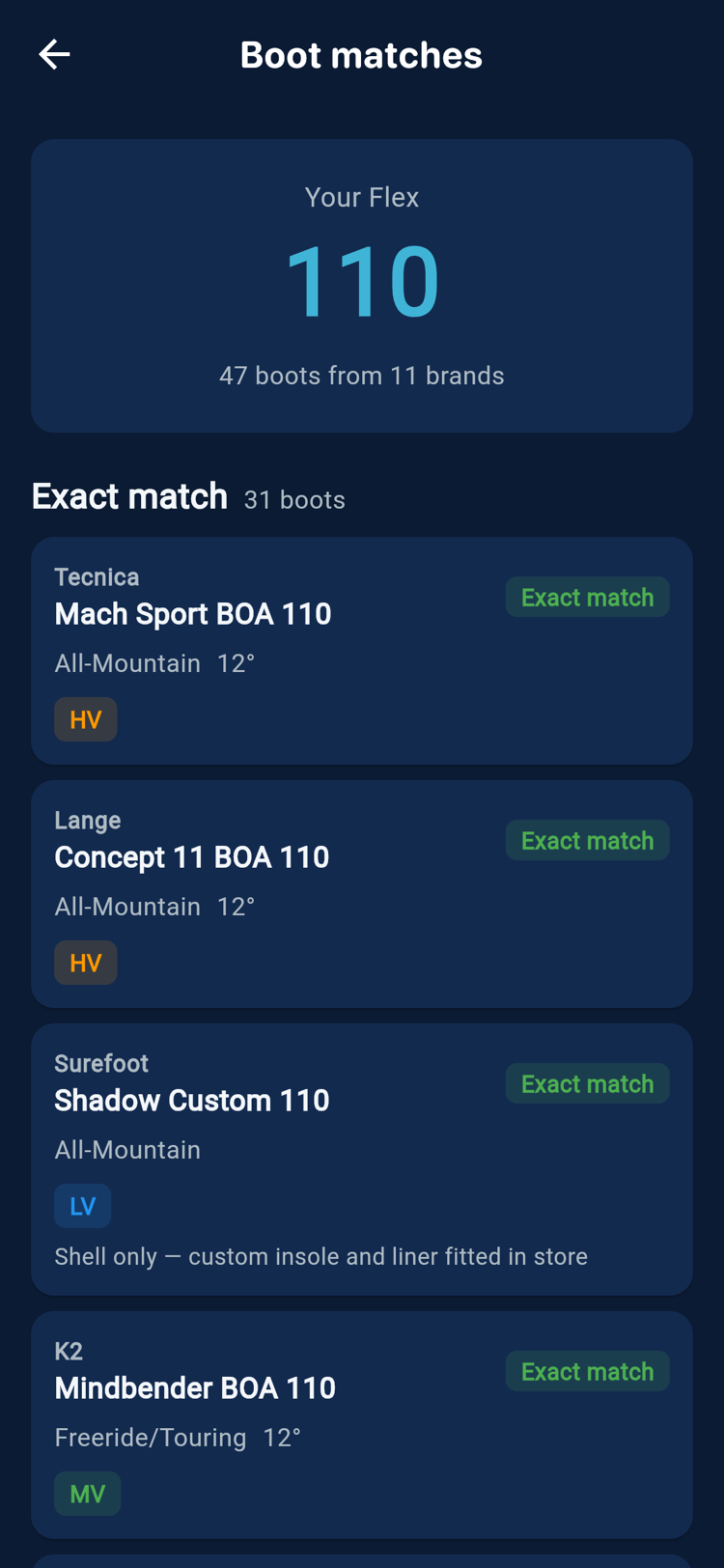
Your matches come from 229 boots across 11 brands: a shortlist to try on with your bootfitter. We sell no boots, and there are no affiliate links.

Download on theApp Store
We sell no boots. Ever.
Boot matches: your flex 110, boots from 11 brands